Why it was never the storms
People often imagine that the hardest part of going to sea must be the storms. They picture the ship pitching in heavy seas, wind shrieking and pounding on the bridge windows, and crew members clinging to whatever they can find. But that has never been the case for me. Storms have their own logic. They arrive, they pass, and everyone knows what to do in between. You prepare, you endure, you clean up. There is a strange reassurance in that.
Or this is how it seems once back on land. While it is happening, the reality is different. In this voyage, we had two bad ones over numerous days. I was not able to get much sleep because of the pitching back and forth. After two nights of little rest, I felt tired and vulnerable. Watching the waves rise over the bow and drown the deck under foaming water was both thrilling and terrifying. The reason the storms were never truly bad had to do with the calm and focus of the officers and crew. I knew they had been through worse and that they were taking care of me. Storms test your nerves, but not your heart.
The true challenges are quieter. They do not crash or roar. They unfold inside you, in the long silences when the mind drifts into places that have little to do with the weather. The sea has a way of revealing what is unsettled in you. When you are surrounded by such vastness, there is nowhere to hide from yourself. But it is fair to say that storms outside are easier to face than storms within.
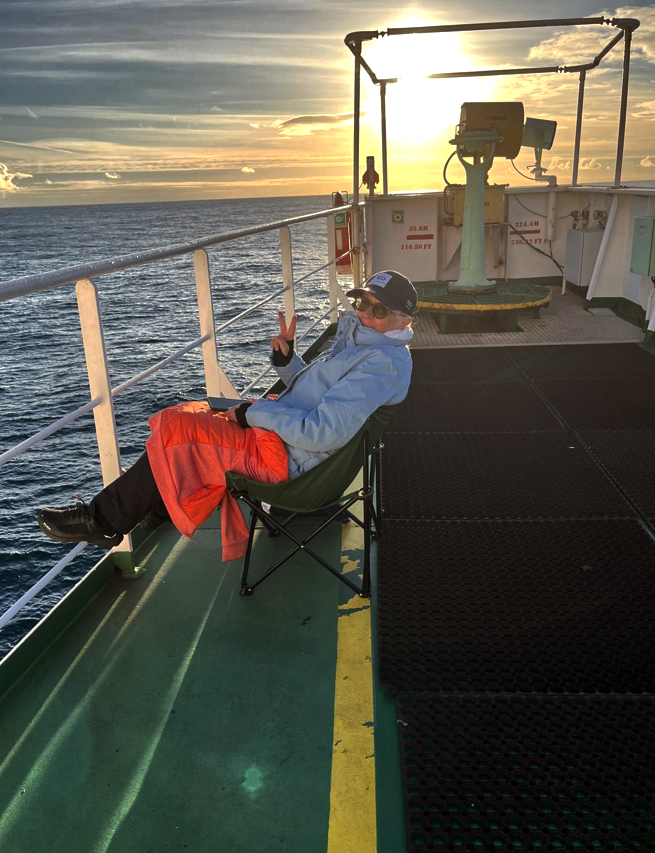
When people ask what the highlight of life on board was, I hesitate. They expect something cinematic: whales breaching beside the ship, sunsets turning the sky into gold leaf, dolphins racing the bow. All of those moments happened, and they were stunningly beautiful, but they are not what stayed with me. What I remember most vividly are the hours spent sitting on deck, when the weather allowed, simply looking out at the sea.
At first, I told myself it was just a habit, a way to pass time between writing and meals. But it became something else. Sitting there, the horizon became both familiar and unknowable. You can watch the waves for hours and never see the same movement twice. The surface shifted constantly, yet nothing really changed. It reminded me of those meditation retreats I attend, where one sits cross-legged for what feels like centuries, counting the breath and trying not to fidget, until the distinction between sitting and being disappears altogether.
There is a kind of walking meditation that happens on board too. You trace the same narrow deck, step after step, meeting crew members with a nod or a wordless smile. Everyone is careful not to disturb the invisible space the others occupy. You learn to move within the ship’s confined world as though in a monastery, aware of the presence of others yet protective of your own sense of calm. Perhaps that is why sitting out on deck felt so deeply restorative. It was meditation without ceremony, mindfulness without effort.
Sometimes I brought a book. Often I did not. The sea told its own story. There were days of pewter-grey skies when the water vanished into fog, and days of blinding blue that felt almost unreal. Once, a line of birds followed us for hours, hovering above the stern as though keeping watch. Another time, three icebergs appeared far off on the horizon, gleaming like glass. It is strange how quickly you accept such things as ordinary.
When the weather turned rough, the deck would close, and I would watch from the bridge instead. Even then, the fascination remained. The sea looked alive, not hostile, just powerful. I began to realise that my time on board was not about adventure in the usual sense. It was about learning to be fully present, to inhabit the same space with intention. There is something humbling about recognising your own smallness without feeling diminished by it.
Now that I am back on land, people ask if I miss it. I do, though not in the way I expected. I do not long for the travel or the distance, but for the way life seemed concentrated into essentials: work, rest, food, movement, attention. There was no constant feed of news or notifications, no unending noise of urgency. The sea allowed for a kind of awareness that daily life rarely grants.
I think often of those hours on deck and the calm clarity they offered. It was not an escape from reality but a sharper version of it. On land, I am trying to find that same awareness again, to sit without rushing, to notice without judging, to stay with what is before me instead of chasing what comes next. It is harder here, where the world pulls in so many directions at once. But I remind myself that I learned it once, and learning something once means it can be learned again.
Storms, after all, are temporary. The sea always settles. And if you are lucky, so do you.
Comments