On carrying home with you
I have been thinking recently about the difference between belonging and feeling at home. They are often treated as the same thing, but I am beginning to suspect they are not even close relatives. Perhaps distant cousins who meet politely at weddings and then avoid each other for the next decade.
This question has followed me for most of my life. I grew up as what is now called a third culture kid. For anyone unfamiliar with the term, it describes children who are born and spend their formative years in countries and cultures different from their parents’. In my case, this meant moving between countries, languages, schools, climates, and social expectations in steady rotation. My childhood passport was stamped not just with entry dates, but with shifting identities.
We also changed houses every few years, which meant that even within one country, any sense of permanence was tentative. Then, at fourteen, I left home completely to attend a girls’ boarding school. At sixteen, I left again to study ballet in France. Looking back, the pattern is unmistakable. My life has been a long sequence of arriving, adjusting, repacking, and moving on.
For many people, belonging grows out of continuity. They are raised in communities where their grandparents lived, where neighbours greet one another with stories that begin, I knew your father when he was your age. There is a steadiness that comes from that kind of rootedness. It forms a web of recognition that holds people in place. Leaving such a world can feel like tearing a net, or pulling up roots that do not want to budge.
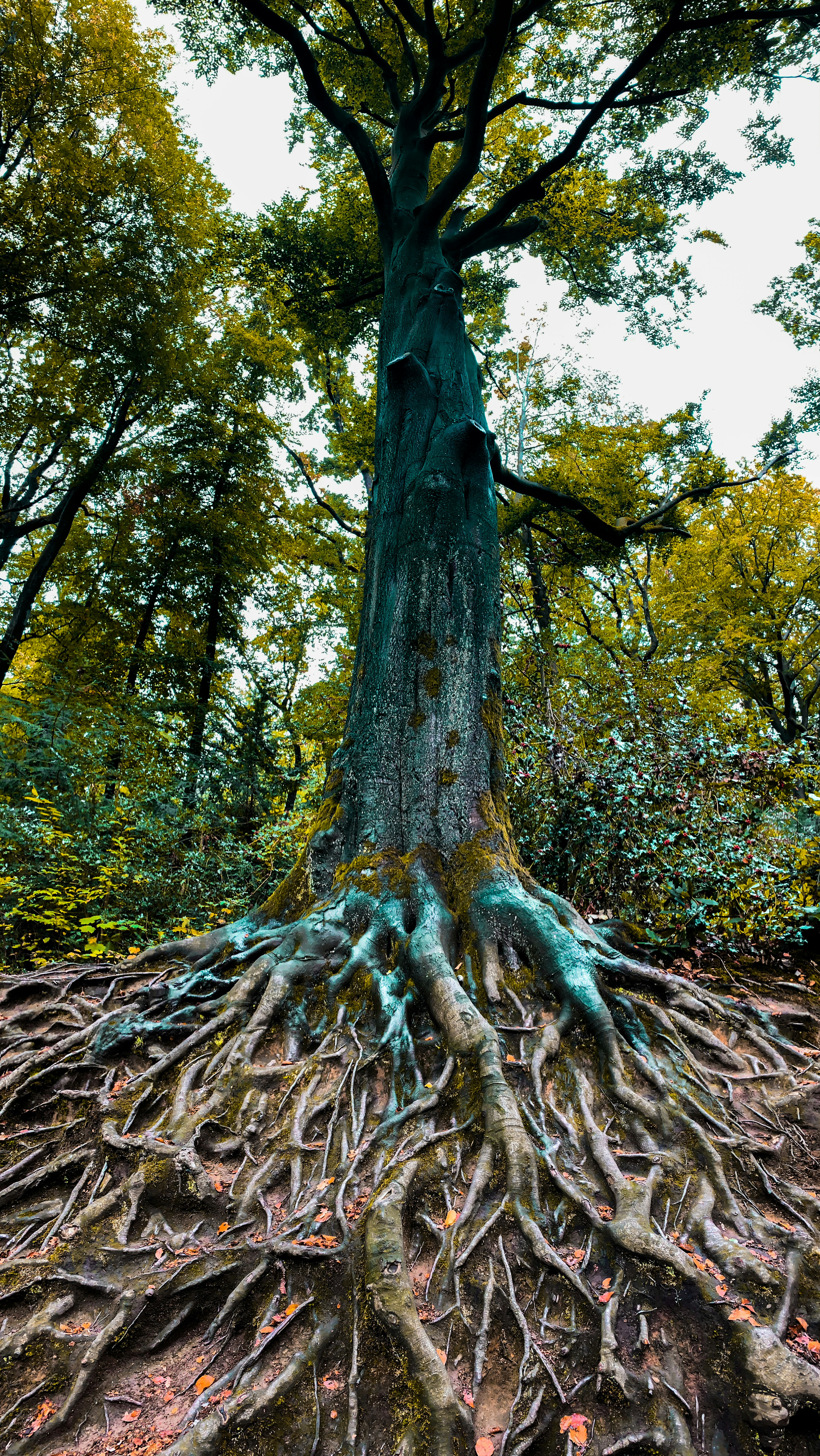
Years ago, I came across a book about trees and their underground root systems. Some species send their roots straight down, deep into the earth, anchoring themselves with impressive focus. Others spread their roots closer to the surface, reaching outward rather than downward, adapting quickly when the ground shifts. I no longer remember which trees belonged to which system, perhaps the willow was one of the latter, but the metaphor stayed with me. Not all stability is vertical. Some of it stretches sideways.
For a long time, I believed something was missing in the way I grew up. I envied people whose childhood bedrooms never changed colour, who could point to one street or tree and say, this is where I come from. Every holiday, their families gathered around tables that had to be extended to accommodate everyone. They ran into neighbours and classmates while walking through shopping centres or standing in supermarket queues. Their lives seemed stitched together by familiarity.
Slowly, I came to understand that belonging does not always grow downward. Some of us are not oak trees, but the other kind, the ones who spread wide. We take root again and again in new soil, and our sense of home comes from adaptability rather than permanence.
That kind of spreading is not always graceful. It involves awkwardness, loneliness, and the discomfort of starting from scratch while everyone else already knows where the teaspoons are kept. The feeling of otherness can weigh heavily, especially when you are the only newcomer in a room of people who have lived in the same community for generations.
Over time, I have learned that feeling at home has less to do with geography and far more to do with welcome. If you walk into a new space and people greet you warmly, if curiosity replaces suspicion, if time and attention are shared generously, a sense of home begins to form.
There is also something to be said for what sociologists call third spaces. These are places that are neither home nor work, yet carry a particular ease. Cafés, libraries, swimming pools, park benches, neighbourhood restaurants, even the corner bakery where the staff begin to recognise your face. These are the safe spaces where feeling at home quietly takes shape.
In one city where I lived for several years, the municipal swimming pool became my third space. I was never a super strong swimmer, but that was beside the point. People nodded at me in the changing room, smiled in recognition, and granted me the comfort of familiarity simply because I kept showing up. Later, it was a library. Then, there was a small café that tolerated my presence for hours in exchange for one pot of tea. These ordinary places became anchors, small domestic harbours in a life with very few fixed points.
What still surprises me is how quickly a place can begin to feel like home once you decide to show up. Not waiting to be invited, not waiting for ideal conditions, but stepping into a world that is not yet yours. This is something many third culture kids learn early. Each arrival begins the process again. You introduce yourself. You listen closely. You learn the unspoken rules. You make mistakes and adjust. If you are fortunate, someone takes you aside and says, let me show you.
It is a strange skill, this repeated replanting of oneself. It is exhausting at times, yes, but also quietly liberating. You learn that home is not something given. It is something built. Sometimes slowly and awkwardly, sometimes with surprising ease.
Perhaps this is the heart of it. Belonging is something a community grants you. Feeling at home is something you learn to cultivate yourself. The first may be conditional. The second is portable. It travels with you, like a small set of internal furniture that somehow fits every new room.
And occasionally, if you are very fortunate, the two meet. You find yourself in a place where you both belong and feel at home. It does not happen often, and it does not need to. Once you have learned to carry home within you, you can walk into unfamiliar spaces and think, I can live here for a while.
Because sometimes belonging is inherited, but feeling at home is a practice.
And like all practices, it strengthens every time we begin again.
Comments