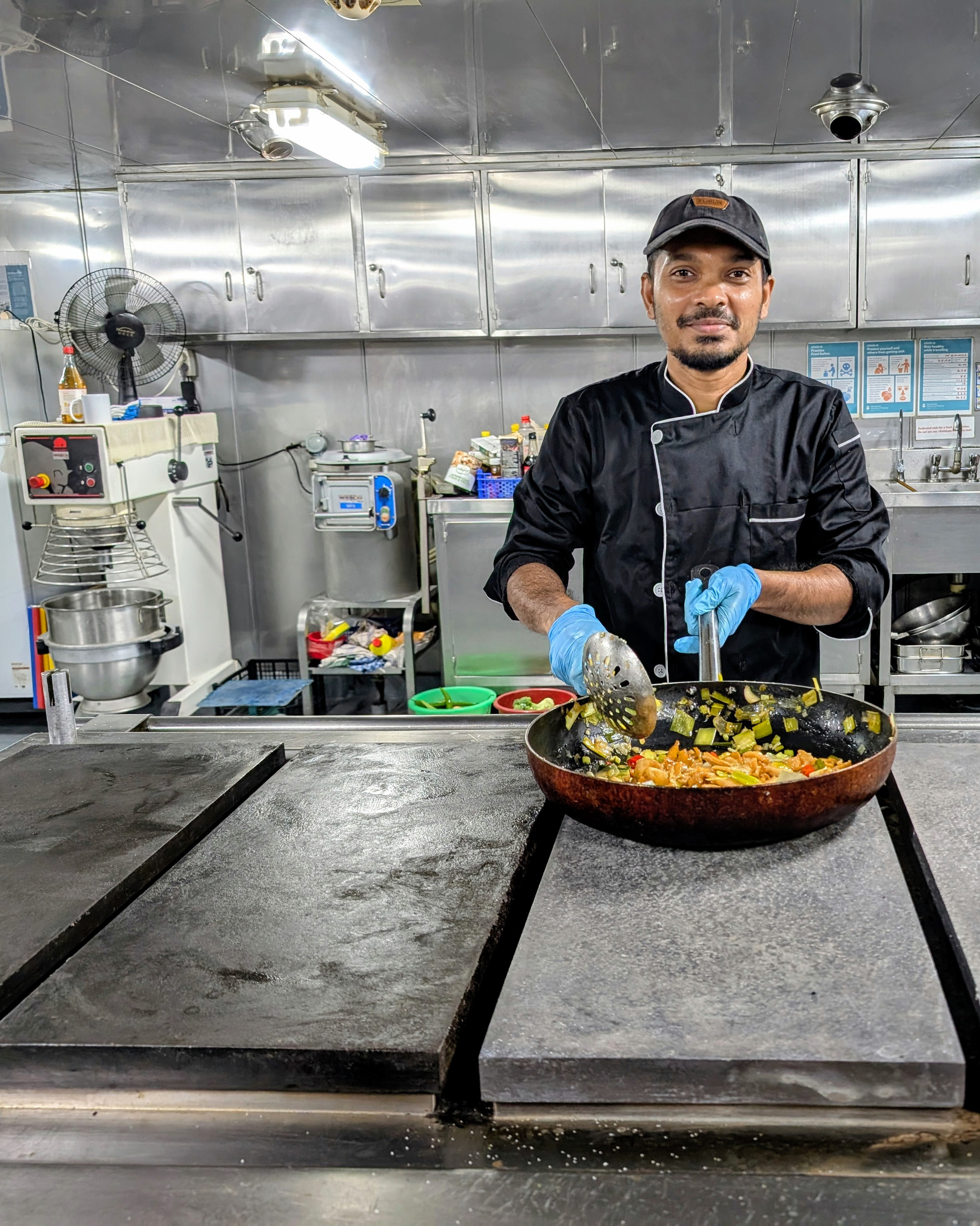
Cook: Sajeewa Abeysundara
by Lia
Keeping the ship fed and the crew together
The ship owners might tell you the captain is the most important person on board. The crew would probably disagree. They know that if the cook is good, morale stays high. If the cook falters, everything else starts to wobble. On our ship, we are lucky. We have Sajeewa.
Three hot meals a day, seven days a week, for 25 people with different tastes and restrictions. No beef for some, no pork for others, smaller portions for one, double helpings for another. He keeps it all in his head and still manages to invent new dishes week after week. Some days it is a new pasta dish, another day he serves us kingfish the third engineer recently caught while they were in Brazil. For someone like me, who is a pescatarian, he quietly makes sure there is always enough variety, so I never feel like an afterthought.
Beyond the meals, there are the logistics of provisioning and planning. Fresh food needs to last as long as possible, stores must be carefully managed, and every item from rice sacks to boxes of biscuits is counted and weighed for the monthly inventory. It is not glamorous work, but without it the kitchen could grind to a halt halfway through a voyage. Thinking of how much coordination is required makes me tired on his behalf. He, however, just gets on with it.
Yet none of this captures his presence. He is humble, steady, and joyful. He notices who might need a little extra on their plate and adjusts without fuss. He recently was given a two-day warning that 13 visitors were coming on board. Could he prepare something for lunch? Of course, captain.
You can taste his care in the food. On Sundays, he makes pancakes for breakfast and serves ice cream with chocolate sauce for dessert at lunch. Small traditions like these anchor the week, give the crew something to look forward to, and create a sense of home in a place that could otherwise feel like just work.
The galley is a confined space, and Sajeewa works there from six in the morning until the evening, with little pause between meals. The steward helps with dishes and serving, but most of the creative and physical labour rests on him. Watching him move between chopping, stirring, and planning the next day’s menu is like watching someone conduct an orchestra, one where the result is not music but a mess hall full of satisfied faces.
In the evenings, when he chats to his three-year-old daughter on screen, you see an important part of his life. The one he lives in Sri Lanka. A house he built, a family he supports, a child who knows her father mostly through video calls until he comes home again. He admits there is always a short adjustment period when he returns, when his daughter must get used to having him in the room instead of on a screen. Then he can spend quality time with his daughter, his wife, and his parents who live nearby.
Sajeewa has been cooking for Oldendorffers at sea for nearly a decade, and he says it is a good life. The job has given him security, the ability to support his family, and pride in the work he does every day. Watching him, I understand why the crew call the cook the most important person on board. His work is never showy, but it keeps the ship running as much as any engine or compass.
It is easy to underestimate the cook, tucked away in the galley. But it is his meals, his presence, and his care that turn a ship of steel and schedules into a place where people can live and work together for months on end.
Comments