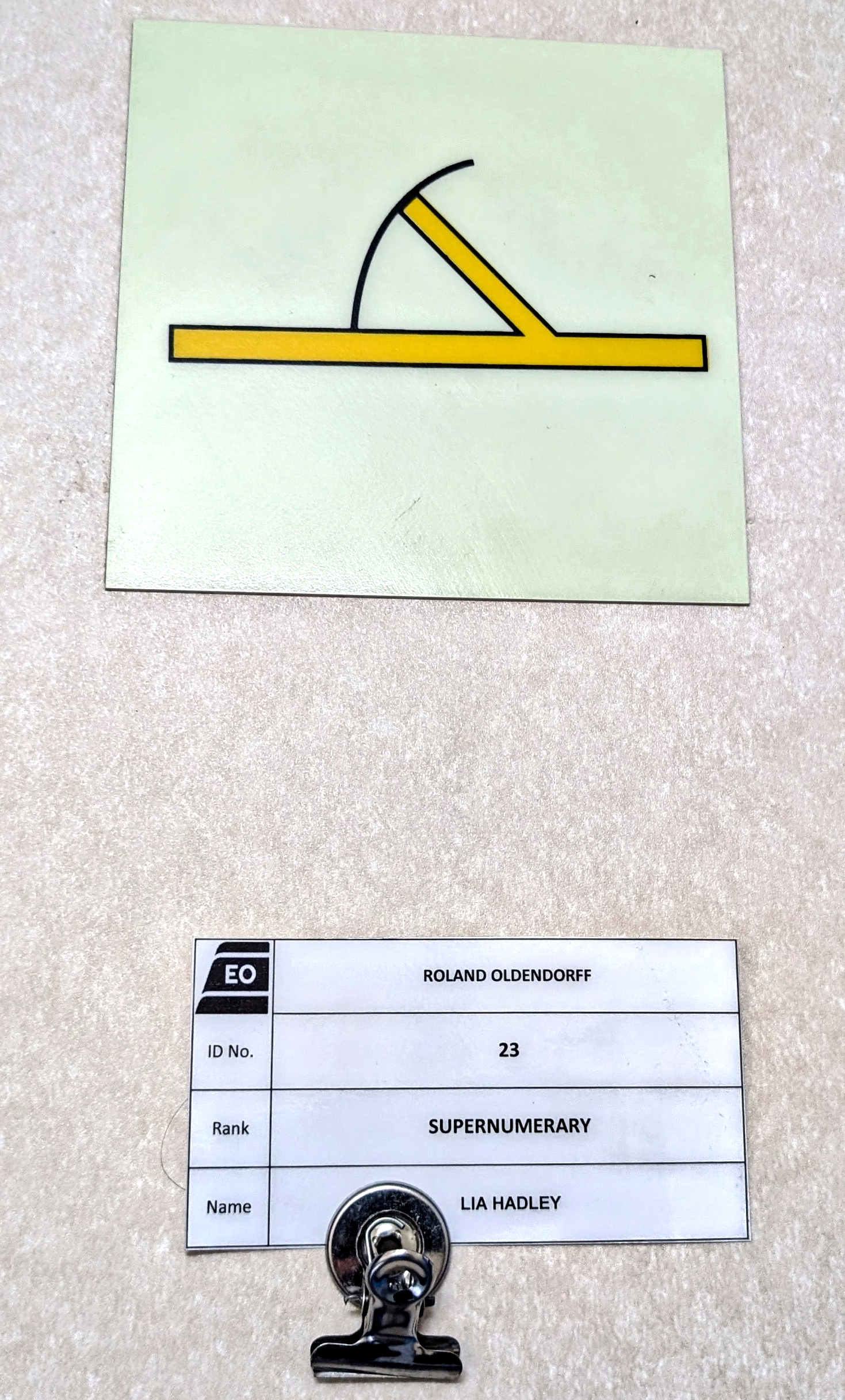
Closing my cabin door
It has been over four weeks since I boarded MV Roland Oldendorff, momentarily my home away from home. What I thought would be an extraordinary and once-in-a-lifetime experience has become ordinary, yet deeply special. And somewhere in the midst of this I have realised that the simplest act on board, closing your cabin door, might be the clearest lesson of all.
There have been a handful of voyages in the last fifty years of my life that, in hindsight, changed me. I suspect this time aboard will also be one of those. There is much I am learning about the people and their work, but just as much about myself and mine.
My family and friends can confirm that when it comes to “work/life balance,” I tilt heavily toward work. Not because I am chasing money or recognition, but because work, for me, is intrinsically tied to creativity. It stretches my brain and makes my heart grow. The danger, of course, is that it can swallow everything. I am rarely without something on the go, and when I have tried to stop, retirement being the most recent failed experiment, I quickly found myself restless.
Life on board has its own version of work and rest. Everyone keeps their shifts, but like chemistry, the rules have exceptions. There are daily reports, inspections, inventories, ballast exchanges, and endless maintenance. Work never truly stops. Yet there is one place where the line is drawn: the cabin door. Close it, and you are signalling that you need space. Unless an emergency arises, no one intrudes. It is as close as you come to privacy and rest.
At home, I have never had a door like this. For the last six years, I have worked remotely, almost entirely from our guest/work room or dining room table I share with my husband. The house is workspace and living space all at once. And in my head, there is no door either. I am either doing work or planning it, the whole day through.
This is not a complaint. Work is mostly joy. Sometimes tedious, frustrating, or baffling, yes, but more often a way to satisfy curiosity. As a dancer, it was about movement, as an engineer, it was about solving problems, as a writer and designer, it is about shaping ideas into form. Even now, as I experiment with AI, I see work less as an obligation and more as an exploration. The tools have their rough edges, but they help me write more, sometimes better. In a way, they act like a silent companion: present when I need them, invisible when I do not.
Here on the ship, I notice how different my rhythm is from the others. For them, the day is defined by watches, inspections, and meals. Work and life blend, but there is a door they can close. For me, the opposite is true. The time in my cabin is dedicated to writing, reflection, and work. The rest of the time, on deck, in the mess, up on the bridge, I step out of myself to connect with others, to look at the sea, to daydream.
It makes me wonder what will happen once this voyage is over. Can I find a cabin door in my life back on land? Not a literal one, perhaps, but some way to draw a line between the work that fills me and the life that surrounds me. I do not know yet what form it might take. I only know that without one, life begins to blur. Perhaps the real lesson here is not only to find the door, but to remember to close it.
Comments